Thank you to all of those who followed my blog during my year in Peru. I could not have embarked on nor could I have endured this journey without your support and encouragement!
For future entries, I invite you to visit my current blog:
"Imperdible: Thoughts on Being Found"
http://www.unloseable.blogspot.com
Monday, April 19, 2010
Tuesday, November 24, 2009
Transformed?
I think I expected to feel some closure by now, to have some sense of what exactly happened to me during the past year. I had hoped there would be a more obvious sign of the transformation that took place. But somehow I find myself right where I left off - asking myself what do I really want to do with my life and how do I want to live it.
I find myself regressing back to a way of life that I had hoped I could eternally escape from – the fast-paced, material-centered, schedule-infected lifestyle that leaves me feeling isolated and lonely. How did this happen? How did I leave everything for another reality and return with so little of it within me?
I want to feel that part of Peru is engrained in me, but I’m not quite sure what to keep and what to let go.
It’s so easy to accelerate life where I am now. To jump in my car, hop on the highway and speed my way to another town or city, attempting to lift my spirits with yet another activity, another event, another distraction.
And as I drive back home, alone in my car, listening to the radio, I stare ahead and wonder what, if anything, did I learn during the past year?
I learned to fill an entire weekend just by lying in bed and reading. I could thoroughly occupy myself by walking to the Plaza de Armas and back, treating myself to pudding cake and peach nectar. I loved hand washing my clothes and continued to even after my host mother invested in the family’s first washing machine.
I felt utterly satisfied every time I wrote a long letter and brought it to the serpost. I would wait for several minutes for the teller to find change and an old lick-on stamp inside her empty desk drawers. I’d then bring the letter to the corner of the post office, kiss the sealed fold of the envelope and slip it inside the small blue box that read internacional, hoping that it would arrive safely.
So much of my time was filled with mundane activities, each providing a joyful ritual for me. What happened to that reverence for the simple? Why do I not feel that same sense of joy?
Partly because I’ve spent the past few months in constant motion.
I’ve moved into a new apartment and acquainted myself with a new town. I have started to work at a women’s shelter. I’ve reconnected with friends and family and returned to dancing with the small company I joined after college.
I’ve packed on just about everything I can to rebuild my life. Yet it’s beginning to dawn on me that reconstructing my life will take something more than just filling time with activity, responsibilities and relationships.
I’ve jumped back into the life I knew before with such ferocity that I haven’t allowed any shifts to take place.
If I am looking for ways that the past year has transformed me, I have to allow the time and space for the changes to emerge here, in this new place. During this season of hibernation, where one slows down and lets life simmer under the surface, maybe I will understand the growth that has taken place.
I find myself regressing back to a way of life that I had hoped I could eternally escape from – the fast-paced, material-centered, schedule-infected lifestyle that leaves me feeling isolated and lonely. How did this happen? How did I leave everything for another reality and return with so little of it within me?
I want to feel that part of Peru is engrained in me, but I’m not quite sure what to keep and what to let go.
It’s so easy to accelerate life where I am now. To jump in my car, hop on the highway and speed my way to another town or city, attempting to lift my spirits with yet another activity, another event, another distraction.
And as I drive back home, alone in my car, listening to the radio, I stare ahead and wonder what, if anything, did I learn during the past year?
I learned to fill an entire weekend just by lying in bed and reading. I could thoroughly occupy myself by walking to the Plaza de Armas and back, treating myself to pudding cake and peach nectar. I loved hand washing my clothes and continued to even after my host mother invested in the family’s first washing machine.
I felt utterly satisfied every time I wrote a long letter and brought it to the serpost. I would wait for several minutes for the teller to find change and an old lick-on stamp inside her empty desk drawers. I’d then bring the letter to the corner of the post office, kiss the sealed fold of the envelope and slip it inside the small blue box that read internacional, hoping that it would arrive safely.
So much of my time was filled with mundane activities, each providing a joyful ritual for me. What happened to that reverence for the simple? Why do I not feel that same sense of joy?
Partly because I’ve spent the past few months in constant motion.
I’ve moved into a new apartment and acquainted myself with a new town. I have started to work at a women’s shelter. I’ve reconnected with friends and family and returned to dancing with the small company I joined after college.
I’ve packed on just about everything I can to rebuild my life. Yet it’s beginning to dawn on me that reconstructing my life will take something more than just filling time with activity, responsibilities and relationships.
I’ve jumped back into the life I knew before with such ferocity that I haven’t allowed any shifts to take place.
If I am looking for ways that the past year has transformed me, I have to allow the time and space for the changes to emerge here, in this new place. During this season of hibernation, where one slows down and lets life simmer under the surface, maybe I will understand the growth that has taken place.

Saturday, November 21, 2009
Brave New Dances
 In early November I performed in BRAVE NEW DANCES, a glimpse of the first drafts of dance theatre works created by members of Maude Baum and Company Dance Theatre. This year I presented a piece reflecting on my experiences in Peru - a blend of folkloric and modern dance in traditional hand-made skirts from Huanuco.
Thursday, October 8, 2009
World Communion
(Read at Hamilton Union Presbyterian Church on World Communion Sunday 10/4/09)
Last year, on World Communion Sunday, I took communion for the first time in Peru. And while we didn’t formally recognize that it was a special Sunday, I experienced a very real sense of world communion - to be in one place partaking in a sacred ritual and at the same time imagining our sanctuary here at Hamilton Union and all of you, taking the same bread and drinking the same grape juice and meditating on our shared devotion.
As I bowed my head in prayer in our church in Huánuco, I placed my hands along the back of the wood pew just as I do here and had that indescribable feeling of being in two places at once - a feeling I experienced many times throughout the year.
During my first few months in Huánuco, I tried very hard to be fully present in my new place. To devote all of my energies to my immediate environment. To really immerse myself - in the language and the day to day relationship building among my host family and co-workers. I consciously detached from my world here in order to adapt.
But as the year continued, especially after the celebrations of Christmas and my birthday and January, I started feeling very homesick. I longed for those who really understand me, who have known me since I was little, those who I can vent to in my own language and listen to them effortlessly without the roadblocks of translation.
I felt so frustrated whenever I was homesick. In thinking of those I missed and loved, the places I longed to return to, I felt distracted and distanced from the present. But I realize now that during those times of homesickness, I was experiencing the realities of world communion.
Like homesickness, entering world communion is uncomfortable because it calls on us to be present in our own lives and to also care deeply for those that are far from us. It is a state of being that makes one feel torn, even conflicted, causing us to ask where we belong and who do we relate to.
I didn’t see this then, but what a blessing! The blessing of being part of one community yet simultaneously immersed in another. That I might have a deep feeling of belonging in more than one place.
The blessing of feeling connected to others even while they are physically far from me. The idea that even while living in Peru, I had a home in another country, belonged to a family in another hemisphere, and shared memories from another corner of the world.
And this is, I think, where the idea of World Communion begins - the ability and willingness to physically live in one place but let your heart and soul reside in many places, among many people – to hold hands with someone from halfway across the world through a deep knowledge of their circumstances and a shared belief that we are connected through our relationship with G-d.
For me, World Communion means sitting down for dinner with my family here in Guilderland and also finding my place at the kitchen table with my host family, Pastor Abdon, Elena and their daughter Carla. One family brings into mind the other, both of which I am part of.
The conversations at each of those gathering places mirror each other, a family sharing about their day, planning for the week, and laughing about the cat and dog as they pace around the kitchen. And while I sit at one table thinking of and longing for the other, I realize that they are in fact the same table.
World Communion is sitting down at the table before me and at the same time sitting down at many tables, and then realizing it is all the same table.
World Communion is also knowing intimately the rhythms and motions of another place - knowing that on any given Sunday in Huánuco the cows at the Granja farm are being milked at 5:00 am. Two hours later, the massive Catholic church in the middle of town will blare praise songs over a loudspeaker. Later in the morning, our pastor will roll up the metal garage door to our newly painted church. And having returned from church and after eating a mountain of tallarines (spaghetti), the entire Camarena household, including me, will retire for a mid-afternoon nap.
World Communion is saying to myself multiple times a day, “If I were in Peru right now, what would I be doing? Who would I be with?"
If I were in Peru this Sunday morning, I would be at church, the Christian Mission Alliance of Huánuco. I would be standing next to Carla whispering together like two little school girls, then singing the opening worship songs nearly drowned out by the electric guitars, drum set and the woman in the front row waving her tambourine. The entire congregation would be clapping to the beat, raising their arms high. And it’s not a question of whether my friends in Peru might be doing this… it’s that they are, right now.
I don’t think we’re called to be in just one limited geographic place, whether it be Guilderland or Huánuco. I think we are called to expand what we name our community and see ourselves as part of a much larger family, sitting at a much larger table.
And it’s wonderful when everyone at that table is having a good day. But what happens when a member of that larger family is facing a difficult challenge? What do we do when a member of that larger family is suffering?
It is difficult to be home and far from those I came to love in Peru and those at Paz y Esperanza, where I worked. It was difficult to leave just as fifteen year old Gladys and her 6 month old baby Luis Migel moved into the shelter on the farm own by Paz y Esperanza. I had become very close to her and I know this transition was not easy for her. How does she feel right now? What is going through her mind?
Accepting the invitation to world communion is challenging because it means acknowledging that the realities at other ends of the table are harsh, saddening and unfamiliar. It is knowing that while I sit down for dinner in my comfortable apartment, with a big kitchen and my own bed, Talia and her brother Eliaquim are going to sleep on an empty stomach because their father didn’t sell enough pop sickles on the streets of Huánuco. The entire family will share two single beds in a closet-sized bedroom.
By entering world communion we recognize that we are from the same community and no longer are others’ struggles a distant concern. World Communion asks us to know intimately the hardships that others have endured and are experiencing at this moment. To listen to stories that are painful and traumatic marked by sexual abuse, domestic violence, civil war, disabling poverty.
By entering World Communion we must prepare ourselves for deep sorrow and ugliness.
But world communion also brings great joy.
World Communion emerged every time I pulled out the piece of orange felt with Ariel’s name on it, another volunteer who I was chosen to pray for while she served in Southern India. While I prayed for her, Celeste was praying for me in Guatemala.
World Communion emerged when I visited a women’s weaving cooperative in Lima that made the bags that were given out at the Presbyterian Women's Gathering in Louisville a few years ago.
World Communion was alive during an evening with my host family, skimming through old hymn books in Spanish, looking for melodies we all recognize.
I think part of me will always reside in Huánuco, Peru. In accepting that, I’m starting to understand what it means to have my heart in two places at once, to live here but simultaneously feel knitted into the daily life and ways of another community.
Having returned home, it is Peru that I am now homesick for. But I have come to believe that homesickness is a holy place, a recognition that while I may never be able to see all those I love in one room, I know that we are indeed at the same table.
Last year, on World Communion Sunday, I took communion for the first time in Peru. And while we didn’t formally recognize that it was a special Sunday, I experienced a very real sense of world communion - to be in one place partaking in a sacred ritual and at the same time imagining our sanctuary here at Hamilton Union and all of you, taking the same bread and drinking the same grape juice and meditating on our shared devotion.
As I bowed my head in prayer in our church in Huánuco, I placed my hands along the back of the wood pew just as I do here and had that indescribable feeling of being in two places at once - a feeling I experienced many times throughout the year.
During my first few months in Huánuco, I tried very hard to be fully present in my new place. To devote all of my energies to my immediate environment. To really immerse myself - in the language and the day to day relationship building among my host family and co-workers. I consciously detached from my world here in order to adapt.
But as the year continued, especially after the celebrations of Christmas and my birthday and January, I started feeling very homesick. I longed for those who really understand me, who have known me since I was little, those who I can vent to in my own language and listen to them effortlessly without the roadblocks of translation.
I felt so frustrated whenever I was homesick. In thinking of those I missed and loved, the places I longed to return to, I felt distracted and distanced from the present. But I realize now that during those times of homesickness, I was experiencing the realities of world communion.
Like homesickness, entering world communion is uncomfortable because it calls on us to be present in our own lives and to also care deeply for those that are far from us. It is a state of being that makes one feel torn, even conflicted, causing us to ask where we belong and who do we relate to.
I didn’t see this then, but what a blessing! The blessing of being part of one community yet simultaneously immersed in another. That I might have a deep feeling of belonging in more than one place.
The blessing of feeling connected to others even while they are physically far from me. The idea that even while living in Peru, I had a home in another country, belonged to a family in another hemisphere, and shared memories from another corner of the world.
And this is, I think, where the idea of World Communion begins - the ability and willingness to physically live in one place but let your heart and soul reside in many places, among many people – to hold hands with someone from halfway across the world through a deep knowledge of their circumstances and a shared belief that we are connected through our relationship with G-d.
For me, World Communion means sitting down for dinner with my family here in Guilderland and also finding my place at the kitchen table with my host family, Pastor Abdon, Elena and their daughter Carla. One family brings into mind the other, both of which I am part of.
The conversations at each of those gathering places mirror each other, a family sharing about their day, planning for the week, and laughing about the cat and dog as they pace around the kitchen. And while I sit at one table thinking of and longing for the other, I realize that they are in fact the same table.
World Communion is sitting down at the table before me and at the same time sitting down at many tables, and then realizing it is all the same table.
World Communion is also knowing intimately the rhythms and motions of another place - knowing that on any given Sunday in Huánuco the cows at the Granja farm are being milked at 5:00 am. Two hours later, the massive Catholic church in the middle of town will blare praise songs over a loudspeaker. Later in the morning, our pastor will roll up the metal garage door to our newly painted church. And having returned from church and after eating a mountain of tallarines (spaghetti), the entire Camarena household, including me, will retire for a mid-afternoon nap.
World Communion is saying to myself multiple times a day, “If I were in Peru right now, what would I be doing? Who would I be with?"
If I were in Peru this Sunday morning, I would be at church, the Christian Mission Alliance of Huánuco. I would be standing next to Carla whispering together like two little school girls, then singing the opening worship songs nearly drowned out by the electric guitars, drum set and the woman in the front row waving her tambourine. The entire congregation would be clapping to the beat, raising their arms high. And it’s not a question of whether my friends in Peru might be doing this… it’s that they are, right now.
I don’t think we’re called to be in just one limited geographic place, whether it be Guilderland or Huánuco. I think we are called to expand what we name our community and see ourselves as part of a much larger family, sitting at a much larger table.
And it’s wonderful when everyone at that table is having a good day. But what happens when a member of that larger family is facing a difficult challenge? What do we do when a member of that larger family is suffering?
It is difficult to be home and far from those I came to love in Peru and those at Paz y Esperanza, where I worked. It was difficult to leave just as fifteen year old Gladys and her 6 month old baby Luis Migel moved into the shelter on the farm own by Paz y Esperanza. I had become very close to her and I know this transition was not easy for her. How does she feel right now? What is going through her mind?
Accepting the invitation to world communion is challenging because it means acknowledging that the realities at other ends of the table are harsh, saddening and unfamiliar. It is knowing that while I sit down for dinner in my comfortable apartment, with a big kitchen and my own bed, Talia and her brother Eliaquim are going to sleep on an empty stomach because their father didn’t sell enough pop sickles on the streets of Huánuco. The entire family will share two single beds in a closet-sized bedroom.
By entering world communion we recognize that we are from the same community and no longer are others’ struggles a distant concern. World Communion asks us to know intimately the hardships that others have endured and are experiencing at this moment. To listen to stories that are painful and traumatic marked by sexual abuse, domestic violence, civil war, disabling poverty.
By entering World Communion we must prepare ourselves for deep sorrow and ugliness.
But world communion also brings great joy.
World Communion emerged every time I pulled out the piece of orange felt with Ariel’s name on it, another volunteer who I was chosen to pray for while she served in Southern India. While I prayed for her, Celeste was praying for me in Guatemala.
World Communion emerged when I visited a women’s weaving cooperative in Lima that made the bags that were given out at the Presbyterian Women's Gathering in Louisville a few years ago.
World Communion was alive during an evening with my host family, skimming through old hymn books in Spanish, looking for melodies we all recognize.
I think part of me will always reside in Huánuco, Peru. In accepting that, I’m starting to understand what it means to have my heart in two places at once, to live here but simultaneously feel knitted into the daily life and ways of another community.
Having returned home, it is Peru that I am now homesick for. But I have come to believe that homesickness is a holy place, a recognition that while I may never be able to see all those I love in one room, I know that we are indeed at the same table.
Thursday, August 13, 2009
Landing
I feel like I’ve been coming home for the past several weeks, months even. In the countdown I began in the upper margins of my journal. In the final letters I sent out to close friends, sealed for the last time with Peruvian postage stamps. In the packing and repacking that I did during my last days, pulling out one more item to give away with each gift or recuerdo I was given.
I knew it was time to leave when all I could talk about was home, my family, my friends, the job I hope to have and the colors I plan to paint my apartment walls. But that did not stop the tears from flowing when I gave one last hug to my host sister Carla at the bus station.
Nor did my face stay dry as I kept in view until the last possible instant, the line of my friends from Paz y Esperanza waving to me from the street as the bus crept around the corner, making its way out of Huánuco. Thus began my longish journey home.
My last ride over the mountains brought me to Lima where I stayed for a week with the other volunteers. We spent most of our time in a quiet Catholic retreat center in the middle of the city, preparing our hearts and minds for “re-entry,” as if returning from outer space.
I don’t think any of us knew what returning would look and feel like, but there was a sense that we might and surely would encounter a sense of the unknown, even in our own home towns.
We took a night plane together to Atlanta, Georgia and then branched off to make our respective flights back home, myself racing through customs only to miss my flight to Albany. With five hours until the next flight, I found I was grateful for the suspended time frame to just sit in the United States and observe the busy airport life.
First observation – how sparkling clean and well-dressed everyone looked, especially children with their McDonald’s happy meals, little backpacks and playing cards.
I sat for a while watching CNN, updating myself on missed news, only to find a repeating loop of three news stories – the investigation into Michael Jackson’s death, Michael Vick returning to the NFL and fortunately something worthwhile to learn about, the Supreme Court nomination of Judge Sonia Sotomayor.
My sudden interest in current events reminded me of when my brother came to visit in December. I whiled away a long layover in the Lima airport by hungrily flipping through the New York Times he had brought and asking him for a rundown of the state of the economy.
It’s not that I didn’t care about world news during the year, but I did narrow down my focus somewhat. There was so much to absorb and understand in my immediate environment that I couldn’t help but detach from certain events and issues that simply seemed a world away.
I slept most of the way during my connecting flight to Albany, letting go of the anxiety I had been carrying. I tend to become increasingly superstitious when traveling home from far away places, worrying that something terrible might happen at the last possible moment.
As we began to lower over the Hudson River Valley, I trusted that we would in fact land in one piece and I was able to simply gaze longingly and lovingly at the landscape below. I’ve never felt so instinctively attached to a particular patch of earth. The color of the trees, the bend in the river, even the imagined smell of pine.
As we drew closer to the ground, more details of life appeared - elements that proved I was no longer in Peru. Free standing homes with sturdy roofs and turquoise colored swimming pools, a well-paved highway that shot out into the horizon, a parking lot filled with beaming yellow school buses. Markers of affluence and security.
With just a few feet separating the wheels of the plane from the runway, I savored the last instant of this feeling of suspension between two worlds, time held still between leaving and arriving.
And then, I was home, on ground that suddenly carried more significance. I was relieved. There was simply nothing else to do but walk into my mother’s arms and then hug my dad, letting loose the rest of my tears and feeling the joy of being welcomed home.
I knew it was time to leave when all I could talk about was home, my family, my friends, the job I hope to have and the colors I plan to paint my apartment walls. But that did not stop the tears from flowing when I gave one last hug to my host sister Carla at the bus station.
Nor did my face stay dry as I kept in view until the last possible instant, the line of my friends from Paz y Esperanza waving to me from the street as the bus crept around the corner, making its way out of Huánuco. Thus began my longish journey home.
My last ride over the mountains brought me to Lima where I stayed for a week with the other volunteers. We spent most of our time in a quiet Catholic retreat center in the middle of the city, preparing our hearts and minds for “re-entry,” as if returning from outer space.
I don’t think any of us knew what returning would look and feel like, but there was a sense that we might and surely would encounter a sense of the unknown, even in our own home towns.
We took a night plane together to Atlanta, Georgia and then branched off to make our respective flights back home, myself racing through customs only to miss my flight to Albany. With five hours until the next flight, I found I was grateful for the suspended time frame to just sit in the United States and observe the busy airport life.
First observation – how sparkling clean and well-dressed everyone looked, especially children with their McDonald’s happy meals, little backpacks and playing cards.
I sat for a while watching CNN, updating myself on missed news, only to find a repeating loop of three news stories – the investigation into Michael Jackson’s death, Michael Vick returning to the NFL and fortunately something worthwhile to learn about, the Supreme Court nomination of Judge Sonia Sotomayor.
My sudden interest in current events reminded me of when my brother came to visit in December. I whiled away a long layover in the Lima airport by hungrily flipping through the New York Times he had brought and asking him for a rundown of the state of the economy.
It’s not that I didn’t care about world news during the year, but I did narrow down my focus somewhat. There was so much to absorb and understand in my immediate environment that I couldn’t help but detach from certain events and issues that simply seemed a world away.
I slept most of the way during my connecting flight to Albany, letting go of the anxiety I had been carrying. I tend to become increasingly superstitious when traveling home from far away places, worrying that something terrible might happen at the last possible moment.
As we began to lower over the Hudson River Valley, I trusted that we would in fact land in one piece and I was able to simply gaze longingly and lovingly at the landscape below. I’ve never felt so instinctively attached to a particular patch of earth. The color of the trees, the bend in the river, even the imagined smell of pine.
As we drew closer to the ground, more details of life appeared - elements that proved I was no longer in Peru. Free standing homes with sturdy roofs and turquoise colored swimming pools, a well-paved highway that shot out into the horizon, a parking lot filled with beaming yellow school buses. Markers of affluence and security.
With just a few feet separating the wheels of the plane from the runway, I savored the last instant of this feeling of suspension between two worlds, time held still between leaving and arriving.
And then, I was home, on ground that suddenly carried more significance. I was relieved. There was simply nothing else to do but walk into my mother’s arms and then hug my dad, letting loose the rest of my tears and feeling the joy of being welcomed home.
Thursday, July 23, 2009
Imperdible
On my last night in Huánuco my host mother and sister surprised me with an unforgettable despedida. I knew a few close friends would be coming over to the house for dinner, but otherwise I was completely unprepared.
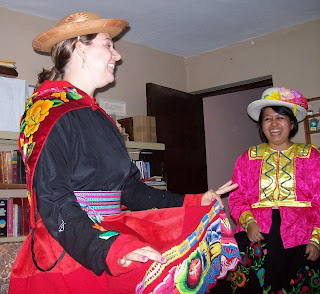
Carla and Elena left the living room to retrieve the “supplies” and returned carrying three plastic bags stuffed with what I dreaded was the guinea pig costume from the office. But then when Carla put on some traditional Huayno music and pulled out a large wool embroidered skirt, I knew just what they had planned.
After taking a few dance classes during the fall and becoming fascinated by the diversity of dance in Peru, Elena had suggested that we rent folkloric dresses one day and have an authentic dance party.
A few local seamstresses stock traditional clothing to outfit local schools for dance competitions. These concursos de danzas are the Peruvian equivalent of homecoming football games, with fans in the rafters whistling, cheering, throwing confetti and rooting for their classmates to win the Marinera from Trujillo or the Saya from Puno.
At home on Tuesday evening, Elena and Carla had pulled out the dress of the Huayla dance of Huancayo, where I traveled during Holy Week. I stepped into two knee-length red and orange skirts, each with a wool border of giant hand-stitched flowers, birds and even pumas from the surrounding jungle of the region.
Elena pulled a black tunic over my head and adjusted the skirts. She then slipped my hands into two decorative sleeves, connected by a string behind the back like a pair children’s mittens.
Over the shoulders is draped a heavy manta, or shawl, usually with a flower pattern square in the middle but sometimes with more personal designs. And, of course, no look is complete without the typical hat of the region.
In Huancayo, the hat is the simplest I’ve seen, a round top low-brimmed felt hat of tan or black with a ribbon that gathers on one side in a delicate fan shape rather than a bow.
This is quite unlike the hats of other regions such as Ambo, for example, a small but busy town just beyond the Granja outside of Huánuco. Here the women take their hats very seriously.
Hats are a bit of a status symbol giving each woman a distinct look, without which the woman look markedly similar, with their dark pleated skirts, knit sweaters and black braided pigtails.
In Ambo, each woman decorates her hat with a mix of bright colored silk flowers, ribbons and even Christmas tree tinsel. Local shops near the market cater to this by hanging all the necessary hat accessories outside their doors, with women coming to refurbish or upgrade their otherwise bland cream-colored top hats.
At first glance the hats seem a bit excessive, but after understanding that these women have few personal possessions, let alone freedoms in life, the hats represent a form of personal expression, identity and artistry.
As Elena continued dressing me in the outfit from Huancayo, Carla tried on a dress from the town of Huacaybamba, a small pueblo near Huánuco. She stepped into a longer black skirt, bordered with a vine of fuchsia flowers. The top was a pink and yellow satin button-up vest with longer panels laying over the sides of the skirt.
Carla then helped Elena put the finishing touches on my Hualya, including a multicolored woven sash wrapped around my waist to hold up the skirt and then a large safety pin to secure the heavy shawl across my back.
She asked Carla for an imperdible to pin the shawl and I remembered how much trouble I’ve had with his word. Sounding nothing like “safety pin,” I had to have my co-worker write it down for me when I was heading out to buy some craft supplies for the office.
Carla, who has been my trusted language simplifier, said it means “unloseable,” derived from the verb pedir, to lose. What an absolutely sensible name for a safety pin!
So, while Elena secured the imperdible and rushed around me making final adjustments for my outfit, I reflected on the new concept of what it means to be “unloseable.” Thinking more during my long bus ride to Lima, it seems this entire year has been a demonstration of what this means.
To be held together, bonded to and constantly surrounded by loving and supportive people.
To work with survivors of abuse who have surely been lost but have arrived at Paz y Esperanza where the message is “You have been found.”
To reinforce my faith and belief in G-d, which tells me that we are all found, already and every day without question.
As it says in Psalms 139 “Oh Lord, you know it [me] completely. You hem me in behind and before, and lay your hand upon me.”
I find this to be so absolutely reassuring, to know that no matter how lost I feel, no matter where I find myself, no matter what happens from here on out, I am unloseable. We are already found, already loved, already assured, already justified and already accepted in every way.
I am re-learning this concept or maybe understanding it more completely for the first time. And I love that what triggered all of this was a tiny pinky-sized safety pin, holding together my shawl so I won’t lose it while dancing in the living room on my last night in Huánuco.
Carla and Elena left the living room to retrieve the “supplies” and returned carrying three plastic bags stuffed with what I dreaded was the guinea pig costume from the office. But then when Carla put on some traditional Huayno music and pulled out a large wool embroidered skirt, I knew just what they had planned.
After taking a few dance classes during the fall and becoming fascinated by the diversity of dance in Peru, Elena had suggested that we rent folkloric dresses one day and have an authentic dance party.
A few local seamstresses stock traditional clothing to outfit local schools for dance competitions. These concursos de danzas are the Peruvian equivalent of homecoming football games, with fans in the rafters whistling, cheering, throwing confetti and rooting for their classmates to win the Marinera from Trujillo or the Saya from Puno.
At home on Tuesday evening, Elena and Carla had pulled out the dress of the Huayla dance of Huancayo, where I traveled during Holy Week. I stepped into two knee-length red and orange skirts, each with a wool border of giant hand-stitched flowers, birds and even pumas from the surrounding jungle of the region.
Elena pulled a black tunic over my head and adjusted the skirts. She then slipped my hands into two decorative sleeves, connected by a string behind the back like a pair children’s mittens.
Over the shoulders is draped a heavy manta, or shawl, usually with a flower pattern square in the middle but sometimes with more personal designs. And, of course, no look is complete without the typical hat of the region.
In Huancayo, the hat is the simplest I’ve seen, a round top low-brimmed felt hat of tan or black with a ribbon that gathers on one side in a delicate fan shape rather than a bow.
This is quite unlike the hats of other regions such as Ambo, for example, a small but busy town just beyond the Granja outside of Huánuco. Here the women take their hats very seriously.
Hats are a bit of a status symbol giving each woman a distinct look, without which the woman look markedly similar, with their dark pleated skirts, knit sweaters and black braided pigtails.
In Ambo, each woman decorates her hat with a mix of bright colored silk flowers, ribbons and even Christmas tree tinsel. Local shops near the market cater to this by hanging all the necessary hat accessories outside their doors, with women coming to refurbish or upgrade their otherwise bland cream-colored top hats.
At first glance the hats seem a bit excessive, but after understanding that these women have few personal possessions, let alone freedoms in life, the hats represent a form of personal expression, identity and artistry.
As Elena continued dressing me in the outfit from Huancayo, Carla tried on a dress from the town of Huacaybamba, a small pueblo near Huánuco. She stepped into a longer black skirt, bordered with a vine of fuchsia flowers. The top was a pink and yellow satin button-up vest with longer panels laying over the sides of the skirt.
Carla then helped Elena put the finishing touches on my Hualya, including a multicolored woven sash wrapped around my waist to hold up the skirt and then a large safety pin to secure the heavy shawl across my back.
She asked Carla for an imperdible to pin the shawl and I remembered how much trouble I’ve had with his word. Sounding nothing like “safety pin,” I had to have my co-worker write it down for me when I was heading out to buy some craft supplies for the office.
Carla, who has been my trusted language simplifier, said it means “unloseable,” derived from the verb pedir, to lose. What an absolutely sensible name for a safety pin!
So, while Elena secured the imperdible and rushed around me making final adjustments for my outfit, I reflected on the new concept of what it means to be “unloseable.” Thinking more during my long bus ride to Lima, it seems this entire year has been a demonstration of what this means.
To be held together, bonded to and constantly surrounded by loving and supportive people.
To work with survivors of abuse who have surely been lost but have arrived at Paz y Esperanza where the message is “You have been found.”
To reinforce my faith and belief in G-d, which tells me that we are all found, already and every day without question.
As it says in Psalms 139 “Oh Lord, you know it [me] completely. You hem me in behind and before, and lay your hand upon me.”
I find this to be so absolutely reassuring, to know that no matter how lost I feel, no matter where I find myself, no matter what happens from here on out, I am unloseable. We are already found, already loved, already assured, already justified and already accepted in every way.
I am re-learning this concept or maybe understanding it more completely for the first time. And I love that what triggered all of this was a tiny pinky-sized safety pin, holding together my shawl so I won’t lose it while dancing in the living room on my last night in Huánuco.

Tuesday, July 21, 2009
Transitions
Last week left me in a mess of disjointed feelings, somewhat similar to the emotional shock I felt during my first few days in Lima. My mind has been emptying itself with each day and gradually I feel more and more at peace with leaving Huánuco. But it has surely been a process of unlayering and finally surrendering to all that is in me.
On Wednesday, I met my host parents for dinner at a new café in town. On any other evening, I would’ve been thrilled to step into this neat little place, with Peruvian artifacts on the walls and new age Andean music in the background. But on this particular night, I just wanted to be alone with my thoughts.
As we sat down, I couldn’t contain myself any longer and I buried my face in my hands, elbows resting on the woven tablecloth, and cried. I couldn’t explain myself and I realized I didn’t have to when my host mom laid her hand on my shoulder and just let me be.
With all the thoughts and plans, faces and memories washing over me, I become aware that I was at the threshold of transition - a time of change that will take me away from Huánuco… and into the rest of my life.
While I felt a certain heaviness on my heart, others grounded me with reassurance and hospitality.
It was my last week in the office and each afternoon during lunchtime I found myself invited into the home of a different co-worker. On Friday I was invited to almorzar with Elía, a quiet woman who works part-time and has shown me much warmth during the year.
We left the office and took a small mototaxi to the edge of town where the paved roads end and sandy pebble-strewn paths lead to a crowded maze of improvised houses. From the outside, Elía’s home looked more like a square box garage, with layers of plastic sheets and styrofoam serving as a roof.
We walked up her front steps, entered the main room of her house and out popped Benjamin, her nine year-old son and also my most precocious English student. Elía sat me down with Benjamin while she slipped into the back kitchen to finish preparing almuerzo.
The main room was divided into three quadrants by a couple of bookshelves and a giant television set. In the limited space, there seemed to be surprisingly enough room for a seating area, dining room and office. But as I mentally cleared away the few pieces of furniture, I realized that the space was no bigger than my bedroom.
Elía soon returned carrying a deep bowl with a mound of rice, chicken, potatoes and camote (sweet potato), drenched in a green herb sauce. I knew instantly what it was – Pachamanca - a traditional meal in Huánuco, served at weddings, baptisms or any other special family occasion.
Pachamanca means “earthen oven” in Quechua, referring to the unique method of cooking all the ingredients underground on hot rocks, the vapor infusing the flavors. I assume Elía prepared the dish in a more conventional oven or maybe a stove-top pressure cooker like my host mom uses.
We were joined by Elía’s older son and husband, who led us in a soft-spoken prayer of which I could hear faintly “Si, Señor” (Yes, Lord) after each pause.
The way this man calmly entered the room and sat down with his family was very telling of the kind of husband and father he is.
Before sitting down, Elía had accidently tipped over one of the glasses of juice, which spread all over the table as it seemed to be on a bit of an incline. In so many homes in Huánuco, this would have incited some ungrateful hideous reaction from the man of the house.
But the man of this house is something entirely different - peaceful, loving, and respectful - an example for his two sons, who seem equally peaceful, loving and respectful.
We ate together over a lively conversation about local food, music and indigenous land rights. I was left completely stuffed, as it appeared that I had been served a double portion.
After clearing the plates, Elía returned with a giant apple and placed it before me. It was probably the most perfect apple I’ve seen so far in Peru, where apples never quite compare to those in New York.
Elía and her husband repeatedly said “Servite, servite” (help yourself). I was hoping this was to share between all of us, as I couldn’t possible eat it all myself.
However, as I cut open the fruit and offered to share it, the whole family seemed to refuse in unison. It was clear that the apple was intended for me and me alone.
In reserving that shiny oversized apple for their lunch guest, I felt the presence of a startlingly true generosity. It was only after I managed to eat two slices and force down a third that Elía and her husband allowed themselves the much smaller apples from the kitchen.
As we prepared to leave, Elía rushed back into the kitchen to retrieve something. She returned with what appeared to be one of the left-over sweet potatoes wrapped up in a sheet of white paper. She presented it to me as a small offering to eat later.
It wasn’t until I returned home after work that I realized it was chunk of fresh cheese. Knowing how much of a luxury cheese is for a family of little means, this was yet another sign of the genuine kindness of Elía and her family.
A kindness that weaved all of my anxious unnamed feelings of the week into a single deeply-rooted feeling of gratitude.
On Wednesday, I met my host parents for dinner at a new café in town. On any other evening, I would’ve been thrilled to step into this neat little place, with Peruvian artifacts on the walls and new age Andean music in the background. But on this particular night, I just wanted to be alone with my thoughts.
As we sat down, I couldn’t contain myself any longer and I buried my face in my hands, elbows resting on the woven tablecloth, and cried. I couldn’t explain myself and I realized I didn’t have to when my host mom laid her hand on my shoulder and just let me be.
With all the thoughts and plans, faces and memories washing over me, I become aware that I was at the threshold of transition - a time of change that will take me away from Huánuco… and into the rest of my life.
While I felt a certain heaviness on my heart, others grounded me with reassurance and hospitality.
It was my last week in the office and each afternoon during lunchtime I found myself invited into the home of a different co-worker. On Friday I was invited to almorzar with Elía, a quiet woman who works part-time and has shown me much warmth during the year.
We left the office and took a small mototaxi to the edge of town where the paved roads end and sandy pebble-strewn paths lead to a crowded maze of improvised houses. From the outside, Elía’s home looked more like a square box garage, with layers of plastic sheets and styrofoam serving as a roof.
We walked up her front steps, entered the main room of her house and out popped Benjamin, her nine year-old son and also my most precocious English student. Elía sat me down with Benjamin while she slipped into the back kitchen to finish preparing almuerzo.
The main room was divided into three quadrants by a couple of bookshelves and a giant television set. In the limited space, there seemed to be surprisingly enough room for a seating area, dining room and office. But as I mentally cleared away the few pieces of furniture, I realized that the space was no bigger than my bedroom.
Elía soon returned carrying a deep bowl with a mound of rice, chicken, potatoes and camote (sweet potato), drenched in a green herb sauce. I knew instantly what it was – Pachamanca - a traditional meal in Huánuco, served at weddings, baptisms or any other special family occasion.
Pachamanca means “earthen oven” in Quechua, referring to the unique method of cooking all the ingredients underground on hot rocks, the vapor infusing the flavors. I assume Elía prepared the dish in a more conventional oven or maybe a stove-top pressure cooker like my host mom uses.
We were joined by Elía’s older son and husband, who led us in a soft-spoken prayer of which I could hear faintly “Si, Señor” (Yes, Lord) after each pause.
The way this man calmly entered the room and sat down with his family was very telling of the kind of husband and father he is.
Before sitting down, Elía had accidently tipped over one of the glasses of juice, which spread all over the table as it seemed to be on a bit of an incline. In so many homes in Huánuco, this would have incited some ungrateful hideous reaction from the man of the house.
But the man of this house is something entirely different - peaceful, loving, and respectful - an example for his two sons, who seem equally peaceful, loving and respectful.
We ate together over a lively conversation about local food, music and indigenous land rights. I was left completely stuffed, as it appeared that I had been served a double portion.
After clearing the plates, Elía returned with a giant apple and placed it before me. It was probably the most perfect apple I’ve seen so far in Peru, where apples never quite compare to those in New York.
Elía and her husband repeatedly said “Servite, servite” (help yourself). I was hoping this was to share between all of us, as I couldn’t possible eat it all myself.
However, as I cut open the fruit and offered to share it, the whole family seemed to refuse in unison. It was clear that the apple was intended for me and me alone.
In reserving that shiny oversized apple for their lunch guest, I felt the presence of a startlingly true generosity. It was only after I managed to eat two slices and force down a third that Elía and her husband allowed themselves the much smaller apples from the kitchen.
As we prepared to leave, Elía rushed back into the kitchen to retrieve something. She returned with what appeared to be one of the left-over sweet potatoes wrapped up in a sheet of white paper. She presented it to me as a small offering to eat later.
It wasn’t until I returned home after work that I realized it was chunk of fresh cheese. Knowing how much of a luxury cheese is for a family of little means, this was yet another sign of the genuine kindness of Elía and her family.
A kindness that weaved all of my anxious unnamed feelings of the week into a single deeply-rooted feeling of gratitude.
Subscribe to:
Posts (Atom)

